Every Landlord who plans to rent their commercial premises should consider in advance which tax settlement route they plan to choose. Each scenario should be taken into account, as well as the intended use of the property. As a law firm specialized in matters related to real estate rental, We provide you with the following guide.
At the end of March 2022, due to the changes introduced by the legislator as part of the Polish Order, we wrote an article in which we describe in more detail the current legal status in the field of commercial premises rental tax. It is available here: Tax on the lease of commercial premises - Polish Order and changes 2022Division of property in the context of commercial premises
The assets of every entrepreneur are divided into two groups. The first is company assets, which include all assets linked to the business activity. The second group is private assets and is nothing more than assets classified for the entrepreneur's personal use. However, from a formal and administrative point of view, both these types constitute a single whole. Taking into account the tax law aspect, which is very important in the case of commercial property rental, separating the assets into two distinct groups is of significant importance.
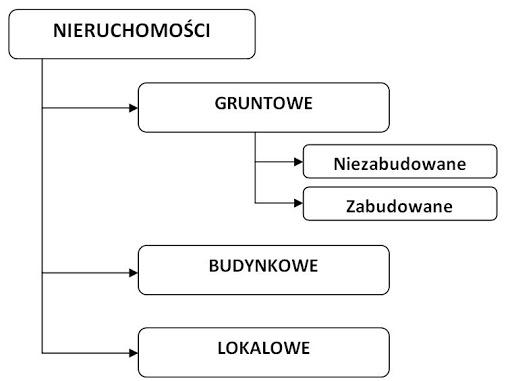
One of the asset components that can be considered from both the perspective of company and private assets is real estate. In the first case, it can actually be any land, building, or premises on which business activity is conducted. The private aspect of real estate is interesting and worth remembering. Some may forget that, apart from a flat or house, which are automatically associated with this term, a commercial property can also be considered real estate. This is precisely why it is necessary to understand the differences between these two forms, bearing in mind the tax aspect.
Income tax
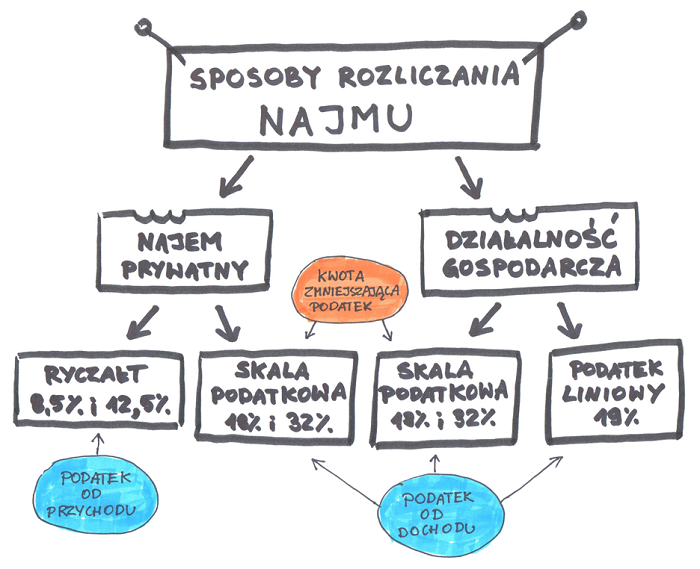
Usually (but not always), the most favourable form of taxation for commercial premises from the landlord’s point of view is the flat-rate scheme. Under this system, if a special declaration is submitted to the Head of the Tax Office by the 20th of January of the relevant year, rental income may be taxed at a rate of 8.5%. The situation is slightly different if the tenancy agreement is concluded during the year – in that case, the declaration must be submitted no later than the date on which the first income was received from the tenant.
In practice, the flat-rate scheme offers the most favourable tax rates. In this case, the rates of 18% or 32% do not apply; only 8.5% (or 12.5% if the rent surplus exceeds 100,000 zł during the year). It is also worth bearing in mind that tax is calculated on the basis of income; consequently, any expenditure on renovating or furnishing the property cannot reduce the amount of tax payable.
The tax scale, on the other hand, is worth applying primarily if you are able to demonstrate relatively high costs incurred in the purchase and maintenance of the flat. This also includes the costs of renovation, furnishings and interest on a mortgage – the latter being quite significant recently.
Importantly, the flat-rate scheme can only be applied in the case of private letting, i.e. when you are not engaged in this activity professionally.
Entrepreneurs who wish to let commercial premises and apply the flat-rate scheme must carefully determine whether the letting of this property meets the definition of a business activity, and therefore whether the letting is of a continuous and organised nature. Administrative courts and tax authorities help to determine whether and when there is a link between the property and business activity. This is the case when:
the subject of the business is professional rental of premises,
the premises were entered into the register of fixed assets,
the premises were purchased or built as part of an economic activity (e.g. not as a fixed asset, but as merchandise),
VAT was deducted from expenses for the purchase/renovation/modernization/construction of premises,
the premises were withdrawn from business and transferred to "private" property for further "private" rental.
VAT
Every company, regardless of its size, is subject to VAT. In relation to the rental of commercial premises, this too is an element subject to tax rules. It is interesting that the authorities can consider the rental as private, having no connection with business activity, and at the same time consider the value of VAT as related to the company. The reason for this situation is the different definitions of business activity contained in tax laws.
Knowledge that VAT on the rental of commercial premises does not have to be paid at all is helpful in this matter. One of two solutions is a lifeline in this regard:
Residential premises, intended for residential purposes, regardless of the rent level, are exempt from VAT,
The exemption from VAT assumes that transactions carried out by an entrepreneur who generated sales below PLN 200,000 in the previous calendar year are also exempt from VAT.
Choosing the right form
When wanting to rent commercial premises, entrepreneurs have three options:
apply a lump sum and issue an invoice for the rent - only if the lease is private and subject to VAT,
rental income can be taxed as a lump sum, and an invoice or bill can be issued - only if the lease is private and the entrepreneur takes advantage of the exemption,
if the lease is of a corporate nature, then PIT and VAT may be settled as part of the business activity.
As a rule, the second and third options are chosen more frequently, whilst the first applies when the property is subject to a flat-rate tax and the annual turnover exceeds 200,000 zł.
In such a situation, the letting of private commercial premises, when subject to a flat-rate tax, also obliges the business owner to issue an invoice with a VAT rate of 23%.
If you have any questions or concerns, please feel free to contact us at initial consultation regarding the lease of commercial real estate - both in terms of taxes and the preparation of a lease agreement that well protects the interests of the owner of the premises. You can arrange a meeting online, and also by e-mail by contacting us at the following address biuro@klodzinskikancelaria.pl, and even by phone. Consultations regarding the lease of commercial premises are settled according to: The Law Firm's price list for business clients.
Rate this post
This website uses cookies to provide services at the highest level. By continuing to use the site, you agree to their use.Agreement